Secondary Research
“Its
fascination and popularity amongst girls of all ages lies in its ability to
provide constant challenge and teach body control, coordination, amplitude and
courage.”
Gymnastics is a sport that has been around since ancient Greece. It is the most watched sport at the Olympic games. Women's artistic gymnastics requires mental and physical strength, determination, confidence, commitment, flexibility, and ultimately passion. |
During the 19th century open air gymnasiums begin to appear throughout Europe and men would perform stuns such as rope climbing to impress women. This is where a lot of the military training came into play as it was considered a great discipline. This is also when the sport in its modern form first evolved. Two styles of Gymnastics were seen; The Swedish system (free-style group exercise) and the German system (using apparatus).
In 1908 and 1912 large groups of women performed gymnastics and by 1928 women were officially competing for the first time at the Olympic games.
Women's artistic Gymnastics today
Being one of the most popular sports at the Olympic Games, artistic gymnastics is also one of the most demanding. It requires not just physical strength but also a great amount of mental strength. The sport requires a unique blend of strength, flexibility, stamina, risk, and artistry. In competition, women perform on the following four apparatuses:
"Vault (VT)
Following apparatus innovation in early 2001, the vaulting horse has now been replaced with a wider vaulting table. It provides the perfect platform from which to launch sky high, before returning to earth with a controlled landing.
Gymnasts approach the vault from a 25metre run, transfer their speed to the springboard and seek a quick hand placement to the table. From here the gymnast uses internal spring to launch themselves vertically for a combination of somersaults and twists. A good vault should land at least 2metres from the table and include no steps on landing
Uneven Bars (UB)
Like the men’s parallel bars the Uneven Bars provide double the challenge for gymnasts. Unlike the men’s bars, the uneven bars are not parallel to the floor with the low bar around 170cm in height and the high bar often around 250cm. The distance between the two bars is set at a maximum of 180cm.
Swinging and continuous movements are required on this apparatus. Routines typically include movements in both directions as well as above and below the bars. Elements with twists and somersaults with multiple grip changes and high flight often are awarded with the highest scores. Like men’s horizontal bar, the wind up and dismount is often the most exciting part of the routine.
Balance Beam (BB)
Perhaps the most precarious piece of apparatus for girls, the beam stands 1.25metres from the floor, is five metres long and if that was not posing enough of a challenge, is only 10cm wide. That is the width of your average house brick!
A beam routine is an exercise in precision with no room for error. The gymnast performs a combination of acrobatic elements, leaps, jumps, turns, steps, waves and balance elements. These can be done standing, sitting or lying on the beam. It is a requirement that the gymnast uses the entire length of the beam, with routines concluding often with a series of acrobatic elements off the side or end of the beam.
Floor Exercise (FX)
The floor exercise allows the gymnast their moment in the spotlight and is considered by many to be the most expressive piece of women’s apparatus.
A floor routine, always accompanied by music, includes a combination of dance movements and sequences interspersed with a variety of tumbling and acrobatic elements. The whole floor area must be used in the routine with clear variances in mood, tempo and direction. Individuality, originality, and artistry of presentation are the key ingredients of a great routine."
-Above apparatus information from: http://www.british-gymnastics.org/site/index.php?option=com_content&view=article&id=43&Itemid=94
Other information from: http://www.olympic.org/artistic-gymnastics-equipment-and-history?tab=History and
http://www.sportcentric.com/vsite/vcontent/page/custom/0,8510,5187-188434-205656-44680-282887-custom-item,00.html
Difficulty score: Difficult and technical content
Execution Score: execution, artistry, composition and technique
The gymnast’s final score is the total of the Difficulty and Execution Scores less any deductions for neutral errors. Here’s an example on how the scoring is calculated. The example uses a woman’s routine.
Difficulty Score
Difficulty# (4C=4x.3, 4D=4x.4, 2E-2x.5) +3.8 points
Element groups (5x0.5) +2.5 points
Connection value^ +0.6 points
Total Difficulty Score 6.9 points
Execution Score*
Base start 10 points
Deductions&
Execution -0.7 points
Composition/artistry -0.3 points
Total Execution Score 9.0 points
Final score 15.9 points
**Above scoring example provided by https://usagym.org/PDFs/Men/fig-scoring.pdf
Famous moments in women’s artistic gymnastics
1972 Olympics: Olga Korbut’s back-flip on the uneven bars: In 1972 Olga Korbut was not considered the best gymnast on the USSR team; however she stole the show when she completed a standing back flip to catch on the uneven bars. Even though this routine only got her a silver medal this “daredevil” move got her well recognised across the world. However, due to regulation changes this move is no longer recognised in gymnastics today. | Montreal 1976 Olympics: Nadia Comenci’s perfect 10: Now considered a household name in relation to women’s gymnastics the Romanian gymnast, Nadia Comenci was the first to score a perfect ten at the Olympics. At the young age of 14 this Romanian gymnast was being considered one of the strongest at the Olympics and then went on to stun the judges and the audience with her flawless uneven bars routine. A perfect 10 was considered impossible to achieve and Nadia was the first in Olympics history to achieve it. After her bars routine she went on to score 6 more perfect 10’s and took home a total of 3 gold medals. She is now considered one the best gymnasts in the world, however due to rule changes and age restrictions, it will be legally impossible for anyone at the Olympics to break this record. |
Los Angeles 1984: Mary Lou Retton's all around win: Mary Lou Retton was the first American gymnast to win Olympic gold for the all-around event. During the 1984 Olympics the Soviet Union boycotted this year. This was an advantage as they were considered at the time was one America’s biggest threats in the Olympics. This then allowed Mary Lou Retton to score her perfect ten on the difficult twist on vault, twice, making gymnastics history for the American team. This then lead her to become a media sensation overnight. | Atlanta 1996: Kerri Strug’s vault During the 1996 Atlanta Olympics, the USA team (now nicknamed the magnificent 7) were on their way to a historic win, when during the last event of the day USA member Dominique Moceanu unthinkably fell on the landing to both her vaults. This then meant that the USA team only had a slim lead in front of the Russians. American gymnast Kerri Strug needed to nail her vault to win the USA gold. During her first vault Kerri Strug also fell, injuring her ankle in the process. However she got up, ignored her injury and did her second vault, perfectly landing on just one foot before collapsing in pain. Kerri Strug’s vault then lead to the American team winning their first Olympic team gold, and instantly becoming a memorable moment in Gymnastic history. |
Similar Projects
A major part of my research was looking into other documentaries and media forms about gymnastics. The following are documentaries that i found to be relevant and influential to my project:
“Gymnast” A documentary by the BBC which followed British gymnasts hoping for a place on the Beijing Olympic team in 2008. I found this documentary very helpful as it captured the emotions of the sport and the passion to succeed. It had moments of heartbreak and moment of success, which illustrated the sport well. The Gymnast is a good job at following the journeys of the Olympic hopefuls and showing each ones own story. Some of the technical aspects such as the quick editing in the intro to the build up using music are elements that I wish to include in my own documentary. | 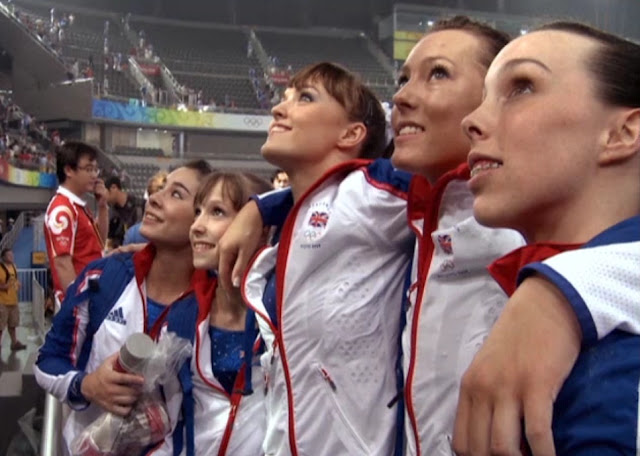 |
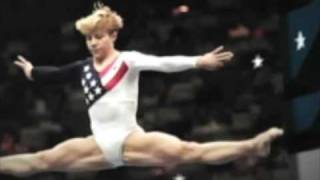 | "The Magnificent 7: Anything to win" This documentary followed the USA Women's Olympics Gymnastics team in 1996 games where they took home the team gold for the first time. This film focuses a lot on the pressure of the US team and the background of each member. It also portrayed the emotional strength required and was a well made documentary that displayed America's victory in the 1996 Olympics. Again, this documentary did a good job at tell the story of the journey of each athlete. In doing so, it captured the strong emotion of the sport and the dedication it takes to be an elite gymnast. |
A different Life- Jenny Pinches "A Different life" is a television programme that aired in 2005. This particular episode was about Gymnast Jenny Pinches. I found it relelvent as she is now retired bu before retiring she competed in the London 2012 Olympics, he ultimate goal. This programe depicted when she first started and how at a young age of 10 she was so detirmed to acheieve victory in the sport. This is very relelvent to my project as it illustrates how young girls are when they first have there "dream. It also showed how the lifestyle of a young girl who wants to take the sport seriously. |  |
Further reading
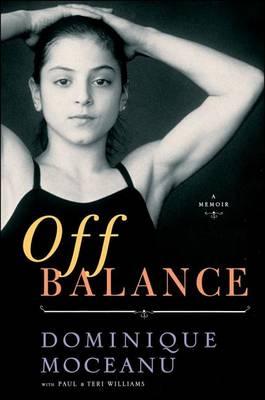 | “As a competitive gymnast, my life has always been filled with challenges that would ultimately define my future. From day one, I was taught to be prepared at all costs. “ -Qoute from Off balance a memoir by Olympic gold medallist Dominique Moceanu Off Balance is a memoir written by Dominique Moceanu an Olympic medallist and one of the USA team members (also called the magnificent 7) during the 1996 Olympics when they took home the gold. She writes about her life in and out of gymnastics, starting her career from the age of 3 when her father enrolled her in a gym. Off Balance sheds a light on the extreme side of elite gymnastics, depicting the life and career of the youngest American gymnast to win gold and how her journey to gold was not as supportive as people would have expected. |
