“In documentary we deal with
the actual and in one sense with the real. But the really real, if I may use
that phrase, is something deeper than that. The only reality which counts in
the end is the interpretation which is profound”
-John Grierson
Documentary film making is becoming more and more prominent in today’s media. It is not simple non-fiction, it is reality shown through the use of entertainment. Documentaries provoke the mind and allow the audience to think about what they have seen and adjust to the realism of it.
Before the term Documentary came to be used, films that depicted reality were known as “actualities”. This is what documentary is seen as; film that shows actual reality. Over the years, documentary film has changed and grown as a genre and form of film making. I feel that documentary is a way of showing the world something honest and truthful.
Documentary modes:
|
Expository Mode |
Characterised mainly by a narration such as a “voice of God”, which is heard but not seen or a “voice of authority” which is usually an expert in the field and is seen and heard in the film. This mode tends to use facts and common sense to persuade the audience of a point of view. |
|
Observational mode |
Often observes everyday life. Also can be known to use the “fly on the wall” technique. This mode often films events in a non intrusive manner by following them as they take their natural course of action. The film maker doesn’t usually interact with the subjects in the documentary. |
|
Poetic Mode |
This mode is seen as a lyrical form of film making. Often used to retell historical events with a more abstract and artistic techniques. This mode moves away from continuity editing and has a very aesthetic film form. |
|
Participatory mode |
This mode involved the film maker in the action by "breaking the fourth wall”. Often the situations seen in the film are altered or affected by the film maker’s presence. This makes the encounters between the film maker and the subject a major part of the documentary. |
|
Reflective mode |
This mode makes the audience aware of the construction of the documentary and flaunts it. It does not necessarily tell the truth but instead “a truth”. The audience are often made aware of the camera, sound, editing ect. |
|
Performative mode |
Depicts emotional and subjective aspects of documentary. This mode often affects different people in different ways by its subject matter and by presenting different ideas. |
Cinema Verite The term Cinema verite is used when discussing the recording of “the truth” in documentary film. Often associated with the breaking of the fourth wall, Cinema Verite aims to capture the moments in documentary film in a natural manner by being unobtrusive and using little editing or any staged sets. This allows the action to be shown in its natural, realistic way. Cine verite is relevant to documentary film making as it challenges the assumption of documentary film being “set up" or “staged” and shows the audience the real truth to the matter. Ethics in documentary When creating a documentary on you own the ethics are solely your responsibility. This can mainly include how the truth is depicting. According to the article “On ethics and documentary: a real and actual truth” the audience’s right to know can dictate the truth that is shown. The idea that the camera can lie also causes and ethical issue in the sense that visually the truth can be seen to b concealed or distorted giving the audience and different side of “the truth” than showing them the actual truth. Truthfulness in documentary poses an ethical issue when it comes to more controversial issues where a documentary is not neutral however it should be the filmmaker’s responsibility to show the truth rather than to manipulate an audience into an opinion.
“For the most part, we think of truth not as some real and existent thing but rather as a relative matter of how one views the world—that is, as a matter of opinion.2 Because some opinions or points of view are always more powerful than others, much of social and cultural theory today will not tell us what is true; however, it will tell us what is right.” For my own documentary, I aim to only show the truth and not manipulate a situation in any format. This is because my film is based on the idea of showing the life of Elite Gymnastics for what it is, a demonstration of passion, commitment, strenth, and emotion. To show these themes I would need to be as truthful as possible as to not decive a viewer in any way.
|
Maslow’s hierarchy of needs As the diagram to the right shows, Maslow founded the theory of human’s needs. The hierarchy of needs is seen as relevant today in understanding human motivation and personal development. As individuals we are each motivated by our own needs. In order to progress to the higher level of need we must make sure our basic needs are fulfilled. | 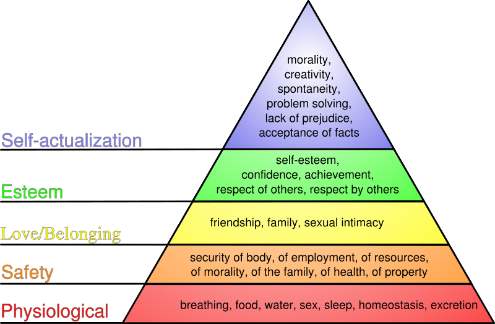 |
Applying Maslow’s hierarchy of need to my own documentary film is relevant in the sense that a major theme in my documentary is reaching a goal. An elite gymnast would have trained for a large portion of her life (possibly from as young of an age as 5 years old) to reach a goal, this goal would fall under their self-actualisation needs. Of course in a lot of instances they do not realise that they have a personal need to excel at such a young age; they tend to realise this when they are older and have more mature capacity to choose what they want. By training and determination they become close to fulfilling their “dream” which they are motivated to do so by their personal need for fulfilment in the sport. This demonstrates a big theme I wish to display in my own documentary; how a need to progress further into a sport motivates an athlete.
|